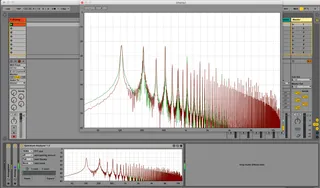
Spectrum Analyzer
FFT spectrum analyzer. Requires the Max external "spectrumd...
- Type
- Audio Effect
- Author
- Razzkazz
- Version
- 1.3
- License
- Attribution
- Live version
- 9.7.3
- Max version
- 7.2.4
- Downloads
- 1,168
- Updated
- 2018-02-28
Spectrum Analyzer is an Audio Effect for Ableton Live by Razzkazz, distributed as Creative Commons Attribution. It targets Live 9.7.3 and Max 7.2.4. On maxforlive.com it has 1,168 downloads. First published 2017-10-26, last updated 2018-02-28. 6 user comments below.
New to Max for Live? Read what Audio Effects do, what the Attribution license means, how to install a device.
Description
FFT spectrum analyzer. Requires the Max external "spectrumdraw~", get it here;
http://eprints.hud.ac.uk/id/eprint/14897/7/HIRT_v1.1.zip
Got any updates ideas?
Updates
Version 1.3 - Added Pop-out/floating window.
Comments (6)
I tweeted @Dublo about making his two devices float, but he said he didn't think he'd be getting around to it.
Device1:
http://www.maxforlive.com/library/device/3417/wavescope
Device2:
http://www.maxforlive.com/library/device/3575/linearscope
I read that @synnack helped @hz37 fix floating issue for his Position device (http://www.maxforlive.com/library/device/2376/position), so maybe he could lend some help?
thanks
Either:
1. Freezing the spectrum and storing and recalling it for reference curve. (Like a matching-EQ).
So, you would recall any saved spectrum you like, (the spectrum recallable in sessions ideally), and the static spectrum curve would sit underneath the current analyzer spectrum. You could then adjust the response time of the active spectrum to be variable all the way up to infinite.
This would let you use saved spectrums as a 'spectral guide' for mixes, busses, instruments etc... (I do this with Ozone 5 all the time, unfortunately they removed this feature from Ozone even though popular.)
2. Use it in almost the same way to create a matching EQ.
It could also store and recall spectrums, and use the real time spectrum to capture the current mix, buss or track with an infinite release time analyzer. After you hit 'stop', you apply an EQ curve made up of the difference between the two spectrums. (maybe limited to a small number of bands... 12, 18, 24 etc...)
Number 2 is obviously difficult, (if even possible in M4L). I'm assuming that's why there isn't one I've seen yet... But hey... Might as well plant the idea!
Cheers and hello. This is my first post here! :)
http://eprints.hud.ac.uk/id/eprint/14897/7/HIRT_v1.1.zip