- Type
- Audio Effect
- Author
- OspreyInstruments
- Version
- 2012.0
- License
- None
- Live version
- 10.1.18
- Max version
- 8.1.5
- Downloads
- 0
- Updated
- No Updates
VOC- is an Audio Effect for Ableton Live by OspreyInstruments, distributed as freeware, with no license specified by the author. It targets Live 10.1.18 and Max 8.1.5. Published 2023-04-09. 3 user comments below.
New to Max for Live? Read what Audio Effects do, how device licenses work, how to install a device.
Description
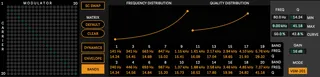
Here is a much-needed update to the VOC-201 vocoder released last year. I completely changed much of the fundamental architecture of the original. For instance, rather than rolling my own crossover filters using biquads, I migrated to using resonant bandpass filters. This gives a lot more flexibility, and stability when changing the frequency bands after the fact. The bandwidth can now be controlled by "Q" parameters. The frequency (in CURVE mode) and Q range are now defined by a function by selecting the endpoints and curve parameters. This ranges your filter distribution and is likely the most powerful shaping method in this device. In VSM-201 mode, the bands revert to the frequencies used by the original hardware, but the Q still follows its curve function. The band gain parameter may be necessary/desirable to adjust when altering the Q.
Taking cues from my additive synth, Partials, and my drum synth, Clapper, I have included band-level (multi-slider) controls for many aspects of the vocoder. I was never totally satisfied with the dynamics/preprocessing section (gate, compressor, emphasis EQ) on the original. I ditched the time-based compressor in favour of hyperbolic tangent (tanh()) functions, which can be easily implemented on a per-band level. This still compresses (saturates), but ignores timing envelopes, which makes it a bit more forgiving when it is implemented this way. The Slew Rate Limiter (attack envelope follower) and Silence Bridging (release envelope) are also both implemented at a band level.
The Voiced/Unvoiced detection engine was also rebuilt from scratch. Not only does it perform better (functionally, not CPU-wise haha), but it has also been opened up with a slew of tunable controls. The comparator sliders, for instance, let you develop the V/UV mix, by scaling how much white noise and carrier signal you'd like for both the unvoiced and voiced modes. The V/UV detection balance should can also be tweaked, although previously calibrated it to switch correctly between consonants and vowels when its around 50% on my voice.
The matrix remains, so wild cross-modulation schemes are possible (and encouraged!). I'd also implore you to open up the device if you are curious how it all works. I tried to make the topography as hierarchal and orderly as possible on the primary signal path, so it should be fairly easy to understand :)
Comments (3)