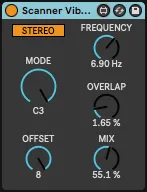
Scanner Vibrato
This is a big update on the scanner vibrato device I made la...
- Type
- Audio Effect
- Author
- OspreyInstruments
- Version
- 2.0
- License
- None
- Live version
- 10.1.18
- Max version
- 8.1.5
- Downloads
- 0
- Updated
- No Updates
Scanner Vibrato is an Audio Effect for Ableton Live by OspreyInstruments, distributed as freeware, with no license specified by the author. It targets Live 10.1.18 and Max 8.1.5. Published 2023-04-16.
New to Max for Live? Read what Audio Effects do, how device licenses work, how to install a device.
Description
This is a big update on the scanner vibrato device I made last year. The old plugin just sequentially crossfaded between simple delay lines, which made a pretty grainy (or "shimmery" if you please) chorus effect, but didn't do much for the frequency/phase response. The LC ladder used by the original hardware (on a Hammond organ) uses a 25-stage LC ladder. Each tap has a progressively more complex response, as the LC ladder acts as a multi-pole allpass and lowpass filter. To capture this complexity, I recreated the LC ladder schematic in LTSpice, and simulated the circuit, creating impulse responses for each tap. I was exceptionally pleased with how well this worked, and the only improvement would be to move to a realtime modelling method like Wave Digital Filters (this wouldn't be easy in Max with out writing a custom external).
The default settings should get you the basic sound. Technically, the chorus modes are already "self-mixing" so the mix parameter should be at 100%, however, I thought it sounded better dialled down a bit. The frequency of the hardware was static (at between 6.9 and 7 Hz) because it was a function of the same motor that drives the tonewheels. Overlap simulates the fringing fields creating crosstalk between the two "active" capacitor plates and the surrounding plates. Probably keep this one low...
Offset chooses where in the sequence the right channel will start from. The left channel uses an up/down counter starting at 0, counting up to 8, then back down to 0. If the offset is set at 8, the right counter will be completely out of phase with the left counter, as it will start counting down as the left starts counting up. This should provide maximum stereo spread and differential delay depth.
In the mono to stereo (m->s) mode, the inputs are summed, and the same input signal is fed to both the left and right ladders. In this mode, the only stereo effect is the result of the offset (the relative scan position between channels).