- Type
- MIDI Effect
- Author
- synthesizerwriter
- Version
- 0.04
- License
- None
- Live version
- 10.0.1
- Max version
- 8.0.0
- Downloads
- 1,591
- Updated
- 2018-05-26
LFOLFO is a MIDI Effect for Ableton Live by synthesizerwriter, distributed as freeware, with no license specified by the author. It targets Live 10.0.1 and Max 8.0.0. On maxforlive.com it has 1,591 downloads. First published 2018-05-13, last updated 2018-05-26. 4 user comments below.
New to Max for Live? Read what MIDI Effects do, how device licenses work, how to install a device.
Description
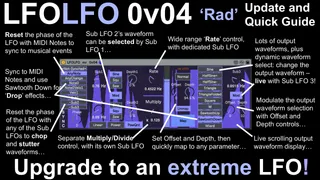
LFOLFO is an experimental 'Multiplying' LFO. It is based on the idea of using modulatable rate controls (now multiplies and divides!) and has three sub LFOs to modulate the Rate, Multiply and Output Waveform controls. Sub LFO 1 can also be used to modulate the output waveform selection of Sub LFO2.
The LFO is always free-running, but the phase can now be reset using MIDI Notes or any of the 3 Sub LFOs. So you can 'sync' the LFO to musical events, or have it wildly free-running...
The Multiply control sets the range of the rate of the LFO. 'Linear' gives continuous numbers from x0.125 to x2048, 'Power' gives powers of 2 at half integer intervals (weird but useful!), and 'PowQnt' is quantised so that it only gives powers of 2 (so 1, 2, 4, 8, 16, 32, 64...). I may add additional laws as I figure out the maths!
I have added visualisers that show the modulation of the rate and the multiply, plus the output waveform (which is now across the whole device!). I'm using my old favourite: the 'multislider scroller'.
This is a very early slightly-polished prototype, and there's lots of refinement to do... I have one or two ideas for additional functionality... (The 'sync' is an experiment to see if not locking it to Live's transport but to MIDI notes is more flexible...)
What can you do with it? Well, try controlling the Multiply rotary control with either the Sub2 LFO or by mapping it to a controller. In 'PowerQnt' mode then the LFO rate changes as powers of 2 (1,2,4,8,16,32, 64...) which can give interesting effects when the LFO is driving filter cut-off...
I will write a blog entry when I get a spare moment!
Back Story:
LFOLFO is a response to a question about an 'extreme LFO' by Russell Alderton on the 'Max For Live Users' group on Facebook. I initially suggested 'ProbablyLFO', but then realised that what was required was a different thing entirely, and so I hacked this together. Development has been rapid as ideas have occurred to me...
In terms of modular equivalents, then reproducing this functionality in my modulars took anything from 6 to 10 separate 'basic' modules, with lots of patch cords (and some limitations), so I'd rate it as about 8 ME.
Comments (4)