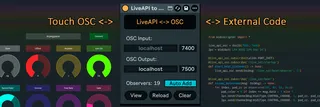
LiveAPI to OSC
This device exposes the whole LiveAPI as OSC addresses. You ...
- Type
- Audio Effect
- Author
- Maboroshy
- Version
- 1.1
- License
- None
- Live version
- 12.0.5
- Max version
- 9
- Downloads
- 70
- Updated
- 2026-08-01
LiveAPI to OSC is an Audio Effect for Ableton Live by Maboroshy, distributed as freeware, with no license specified by the author. It targets Live 12.0.5 and Max 9. On maxforlive.com it has 70 downloads. First published 2026-07-28, last updated 2026-08-01. 1 user comment below.
New to Max for Live? Read what Audio Effects do, how device licenses work, how to install a device.
Description
This device exposes the whole LiveAPI as OSC addresses. You can map Live controls to TouchOSC or any other OSC app, get or set anything Max for Live can by OSC messages.
How to Use
- Find object's property or function path you want to use in Live Object Model documentation at "https://docs.cycling74.com/apiref/lom/". Put "/" at the beginning and replace spaces with "/" for its OSC address. "live_set tracks 0 mixer_device volume value" should become "/live_set/tracks/0/mixer_device/volume/value".
- You can enable "Max for Live Developer Mode" in Live's "Options" menu and use "Copy Max for Live path" item in controls' context menus to get their addresses.
- Send an OSC message with no arguments to get a property value.
- Send an OSC message with an argument to set the property value. For easier parameter mapping you can use the parameter value scaling described below.
- To call a function send an OSC message with an argument prepending the function name with "/call/".
- You can also use "/id/31054/property" style addresses if you know the object's ID. The IDs are dynamic and should not be stored and used over multiple runs.
Examples:
/live_set/appointed_device/name - returns "blue hand" device name
/live_set/midi_recording_quantization 2 - sets midi recording quantization to 1/8
/live_set/call/create_scene -1 - add the new scene after the last one and returns its ID
Observing
With "Auto Add" enabled, any OSC message adds an observer for the address if it's observable.
Observed addresses are saved within the Live set. Use "View" button to view and edit the saved observers, press the "Reload" to apply changes.
If you don't want to use "Auto Add" you can set observers manually. Add "/observe" to the address and send "1" argument to add and "0" argument to remove an observer.
If the observed object at the address changes, the new object ID is sent with "/id" appended to the address to distinguish it from a value.
Example:
/live_set/current_song_time/observe 1 - set an observer for current song time in beats
Parameter value scaling
Parameter "value" property units, minimum and maximum varies between parameters.
To provide more stable mapping the device introduces "/scaled_value" parameter property which gets and sets parameter value as a floating-point number between 0 and 1 of the parameter’s range.
Examples:
/live_set/tracks/0/devices/0/parameters/1/scaled_value - gets the value of the second parameter of the first device on the first track as a floating-point number
/live_set/tracks/0/devices/0/parameters/1/scaled_value 0.5 - set the parameter value to 0.5 of its range
Address matching
The device supports "*" matching for digit only address items.
Examples:
/live_set/tracks/*/name - gets comma separated list of all track names
/live_set/tracks/*/devices/*/name - gets the list of all the top-level device names on all tracks
/live_set/tracks/0/devices/*/parameters/0/value 0 - disables all the top-level devices on the first track
Extra addresses and actions
When device is loaded, it sends a message to "/live_set/startup" address.
Use "/live_set/beat" address to get/observe the current beat number in measure.
There are Max JS API actions you can add to an address:
/children - returns object's children IDs
/getcount - returns the number of the object's children
/getstring - returns property of the object as a string
/id - returns the object's ID
/info - returns a description of the object, including id, type, children, properties and functions
/path - returns the object's path
/proptype - returns the type of the property or child
/type - the object type
The device is also hosted on GitHub with my other free devices:
https://github.com/Maboroshy/Max-for-Live-Devices/
TouchOSC demo used in preview is also hosted there.
Licensed under the GNU Lesser General Public License v3.0 (LGPL‑3.0).
Changelog
v1.1 - 01.08.2026
Fixed message echoing (still double messages on setting the observer)
Fixed observer handling
Implemented observer ID changes notifications
Comments (1)
Is it possible to select a track in touch osc (using a button) that reflect the state of being selected or not selected,
Like arm or not armed?
Eg. "/live_set/tracks/10/arm"