- Type
- Instrument
- Author
- OspreyInstruments
- Version
- 1.0
- License
- None
- Live version
- 10.1.18
- Max version
- 8.1.5
- Downloads
- 0
- Updated
- 2023-01-22
Snap is an Instrument for Ableton Live by OspreyInstruments, distributed as freeware, with no license specified by the author. It targets Live 10.1.18 and Max 8.1.5. Published 2023-01-22. 2 user comments below.
New to Max for Live? Read what Instruments do, how device licenses work, how to install a device.
Description
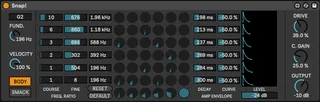
Snap! is a snare drum synthesizer, inspired by Venus Theory's video on snare drum modelling via FM Synthesis:
www.youtube.com/watch
It features a full FM routing matrix (including self-modulation feedback loops), with all operator parameters (frequency ratio, matrix row, decay envelope) displayed inline and one a single page. There is a second tab that displays the noise generators that make up the transient and high-frequency components of the sound.
The synth does not respond to midi note pitch information, rather the fundamental frequency / note pitch can be edited via interface parameters. The frequency of each operator can be set with ratio parameters that relate their frequency to be a multiple of the fundamental frequency, allowing it to scale nicely.
There are three included effects: overdrive, compression, and a transient designer. The latter two require the installation of the free Kilohearts Essential Bundle to work (or for the device to work at all for that matter). I would have loved to design these from scratch, but I haven't shelled out for a gen~ licence yet (required for sample-accurate patching). The vst3 versions of the plugins can be downloaded here:
kilohearts.com/products/kilohearts_essentials
Video Demo:
https://youtu.be/nrTUozjF5n4
Comments (2)
Would love to have a randomise button for the matrix.
A randomise button would be a really nice feature, but I shutter at how much work that would be to implement! haha (although there may be some methods for working with the matrix objects that I am not aware of).
The probability would have to be weighted at the lower end of the value structure too, especially on for the diagonal (feedback) cells. I'll have to think this over and see if I can come up with an efficient way to structure it. :)